
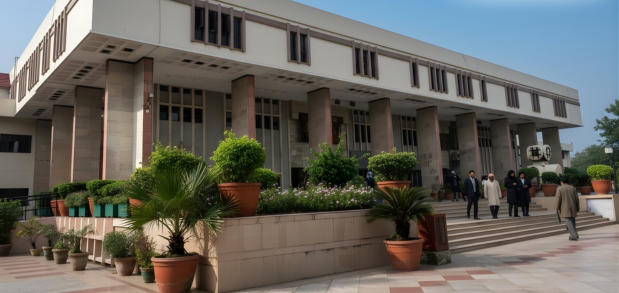
In a significant ruling at the intersection of military discipline and workplace harassment law, the Delhi High Court has been called upon to examine whether a Border Security Force Sub-Inspector, facing a General Security Force Court sentence over allegations of sexual harassment at a remote border outpost, can bypass the statutory appeal mechanism and directly invoke the Court’s writ jurisdiction to challenge the entire chain of proceedings, from the Internal Complaints Committee’s reconstitution to the chargesheet and uncommunicated GSFC findings.
The petition, filed by the BSF officer against the Union of India, raises pointed questions about procedural fairness under the POSH Act, the principle of coram non judice, and whether a uniformed force officer is entitled to the same protections as civilian government employees, questions the Court has agreed to examine, but not yet.
The controversy began on the intervening night of January 13-14, 2025, at Border Outpost Tash in Pathankot, Punjab, where the petitioner, posted as Officiating Company Commander, discovered a woman Constable allegedly sleeping on duty at the critical LCTS surveillance room during a dense fog alert. According to the petitioner, he shook her awake, reprimanded her for dereliction of duty, and subsequently met her days later to apologise for anything perceived as inappropriate, a conversation the Constable herself recorded.
The BSF’s version, however, was starkly different, the ICC found that the petitioner had held the Constable’s hand, pulled her jacket toward him, offered personal friendship, shared his mobile number with instructions to contact him, later questioned why she had not called, and crucially, used his official position to conditionally approve her roommate’s leave only if she agreed to befriend him.
When the complaint was filed, the initial ICC proceedings were annulled because its Presiding Officer was male, violating Section 4 of the POSH Act. A reconstituted ICC of three members, not four as mandated, returned findings of misconduct, triggering a Record of Evidence, a chargesheet dated January 12, 2026, and a GSFC that announced its findings and sentence. The officer, contending that the ICC suffered from coram non judice, lacked quorum, and violated natural justice, rushed to the Delhi High Court, while simultaneously filing a pre-confirmation appeal under Section 117(1) of the BSF Act.
The Court found a fundamental procedural infirmity in the petition, not in the BSF’s proceedings, but in the petitioner’s own timing. The Court zeroed in on the fact that the pre-confirmation petition was still pending before the competent authority, making any High Court interference at this stage entirely premature. Critically, the Court noted that every ground urged before it had also been raised in the pre-confirmation petition, making judicial intervention doubly unnecessary, “It is a settled position of law that till such time a final order is passed in the proceedings of this nature, any interference without waiting for the final decision on the proceedings by the High Court in a writ petition is uncalled for.”
The Court further clarified that once the pre-confirmation petition is decided, the petitioner retains the remedy of a post-confirmation appeal under Rule 117(2) of the BSF Rules, leaving all contentions alive for the appropriate forum. Consequently, the petition was dismissed as premature along with all pending applications.